Hong Kong – making progress in sustainable debt
29 Jul 2022
Strong issuance and a string of landmark deals are improving Hong Kong’s status as a major centre for sustainable finance. Over the last 12 months, we have seen the city’s capital markets successfully fund a range of sustainable projects. But for this momentum to continue, Hong Kong needs to nurture enough talent to meet the growing demand for sustainable finance.
In this update on sustainable finance, we highlight the need-to-know developments in Hong Kong’s green debt market, with some considerations on how the city will nurture sustainability professionals.
A broader and deeper market
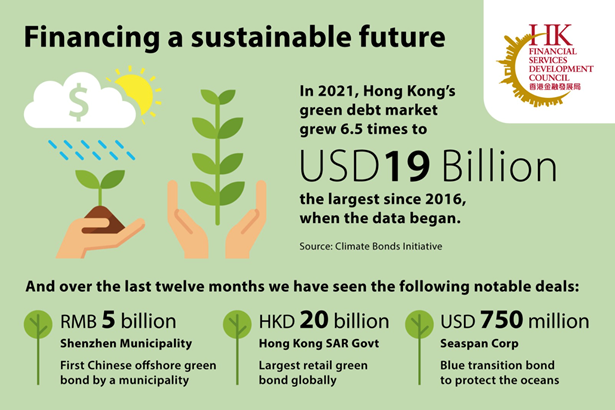
In its recently released market analysis of 2021, the Climate Bonds Initiative (CBI) highlights that Hong Kong’s green-labelled debt market last year grew to USD19 billion, growing 6.5 times on the previous year1. This represents the largest increase, in both absolute and percentage terms, since 2016, when the CBI data starts.
In terms of issuers, CBI noted that the Hong Kong SAR Government was particularly active, raising more than USD6 billion with six deals in 2021. Corporates, both financial and non-financial, raised an additional USD3.5 billion. Out of the 12 issuers that issued green debt or borrowed via green loans, nine were new to market – such as Hongkong Land and China Development Bank (Hong Kong Branch), which both issued their inaugural green bonds.
The CBI summarises Hong Kong’s potential, saying that the city “is well-positioned to strengthen its role as an international green and sustainable financial hub, given its solid business infrastructure, high degree of internationalisation and established engagement with nearby regions and countries.”
Standout deals
Perhaps the most notable deal in sustainable debt over the year was a Chinese offshore green bond issued by the Municipality of Shenzhen. This RMB-denominated bond not only marked the first time that a municipal government in Chinese Mainland issued an offshore green bond, but is also a good example of Hong Kong and Shenzhen working together to realise the vision of the Greater Bay Area. The bond’s proceeds will be used to fund new high schools, water treatment plants and subway projects2.
In May, Hong Kong’s first green bond for retail investors raised HKD20 billion (USD2.6 billion)3. This was the largest retail-focused green bond globally, and the popular deal was oversubscribed, suggesting high levels of interest among Hong Kong’s individual investors for sustainable investments.
Away from green bonds and loans, there was activity in other thematic debt instruments. Seaspan Corporation for example, the world’s largest independent owner of containerships, issued a USD750 million blue bond4 – a new kind of debt security where the proceeds are directed towards the oceans and the economies that depend on them.
Nurturing sustainable talent
Hong Kong’s rapid progress in sustainable finance is a natural extension of its longstanding role as one of the world’s leading capital raising venues. But sustainability is not a short-term trend. It marks a fundamental shift that will influence investment decisions for decades. In order for Hong Kong to keep at the forefront of this transition, it will need to ensure that it has sufficient talent in the three areas that make up ESG – namely, environmental, social and governance.
Our research has found that in Hong Kong, international investment houses already have ESG as a top priority, while regional and local firms still coming to terms with sustainability5. Although there are shortages of ESG talent in all regions, the shortfall is most acute in Asia, creating challenges for managers that need to add headcount to engage in sustainability.
Employers in Hong Kong can be open-minded in how they select candidates, since there is not a specific academic background that makes someone qualified to work in an ESG-related role. The single-most important factor whether a candidate can translate ESG concepts into actionable strategies. For senior management, this will require being a visionary and driving change in the company, while junior staff will only require a basic knowledge of sustainability.
The good news is that there is enthusiasm among university students to enter the ESG field, with more than 60% of respondents to an FSDC survey saying that are likely or very likely to consider the sector. The main reason cited was that the ESG sector offers better career prospects, with the chance to do meaningful work the third-most popular response.
Today’s students will become the next generation of leaders in the financial sector. Their interest in ESG will help ensure that Hong Kong will have the professionals it needs to continue raising significant amounts of capital for green and social projects. This makes us confident that Hong Kong will maintain its leadership in sustainable finance – not just over the short term, but for many years to come.
3 Hong Kong Monetary Authority
4 Seaspan